How to Manage and Enhance Brand Touchpoints in 2025

Brands in 2025 must adopt strategies that put the customer at the center of every journey. Modern management relies on technology to streamline each customer interaction and optimize every step of the journey. Businesses now compete on customer experience, with 89% prioritizing this over product or price.
Unified digital experiences drive loyalty and retention, as customers expect seamless engagement throughout the journey. Consistency across channels shapes perception and influences every journey decision. Brands.menu empowers teams with management tools that reveal the entire customer journey, ensuring no brand touchpoints go unnoticed. Leaders must ask if their journey management delivers the experience customers now demand.
Key Takeaways
Every interaction a customer has with a brand shapes their experience and loyalty, so managing all brand touchpoints carefully is essential.
Mapping the customer journey helps identify key moments to improve and ensures a smooth experience from awareness to advocacy.
Using omnichannel strategies creates seamless, consistent experiences across all platforms, boosting customer retention and sales.
AI and automation enable brands to deliver personalized experiences at scale, freeing teams to focus on innovation and strategy.
Tracking key metrics and gathering customer feedback regularly supports continuous improvement and stronger brand loyalty.
Brand Touchpoints Overview
What Are Brand Touchpoints
Brand touchpoints represent every interaction a customer has with a brand, both online and offline. These include digital ads, social media posts, website visits, customer service chats, and even product packaging. Each touchpoint shapes how customers perceive the brand and influences their decisions throughout the journey.
Modern marketing research uses advanced attribution models to assign value to each touchpoint. These models move beyond last-click metrics, offering a clearer picture of which interactions drive engagement and conversions. Marketers now rely on digital tracking tools, such as web analytics and CRM systems, to collect detailed data on consumer behavior. Machine learning further personalizes messages, increasing the effectiveness of each brand touchpoint.
Note: Cluster analysis and behavioral data, like heatmaps and user session recordings, help brands identify where customers engage most and where they drop off.
Why They Matter in 2025
In 2025, brand touchpoints play a critical role in building loyalty and driving growth. The shift toward digital channels continues, with forecasts showing digital marketing will account for 59% of global ad spend. Automation, AI, and omnichannel strategies boost sales and engagement, making every touchpoint more valuable.
Media Type | 2024/2025 Forecast / Comparison Highlights |
|---|---|
Digital Channels | 59% of global ad spend; automation and AI drive higher engagement. |
Television | 23% of global ad spend; declining relevance compared to digital. |
Print Media | 6% of global ad spend; continued decline. |
Inbound Marketing (Digital) | 54% more leads, double conversion rates over traditional methods. |
Marketers use key performance indicators like conversion rates and customer retention to measure the impact of each touchpoint. Surveys and feedback provide insights into customer perceptions, helping brands refine their strategies. By mapping the full journey and understanding the influence of every brand touchpoint, businesses maximize return on investment and deliver consistent, compelling experiences.
Customer Journey Mapping

Identifying Key Touchpoints
Customer journey mapping begins with pinpointing every interaction a customer has with a brand throughout the lifecycle. Each journey stage, from awareness to advocacy, contains unique customer touchpoints. These touchpoints include digital ads, website visits, social media engagement, and post-purchase support. By identifying these moments, teams can understand how customers move through the lifecycle and where they encounter friction.
A clear customer journey map highlights the most influential touchpoint at each stage. For example, the awareness stage may focus on website traffic and social media reach, while the decision stage emphasizes conversion rates and sales metrics. Customer lifecycle management relies on this mapping to ensure no critical moment is overlooked. Teams that map the journey can optimize brand touchpoints and deliver a seamless experience across the lifecycle.
Tip: Involving stakeholders from marketing, sales, and support ensures a comprehensive view of the customer journey and lifecycle.
Journey Mapping Tools
Modern journey mapping tools empower brands to visualize and optimize the entire customer lifecycle. These platforms track customer behavior, identify pain points, and reveal opportunities for improvement. Companies like HubSpot, Starbucks, and IKEA have used journey mapping to refine onboarding, personalize rewards, and enhance both online and offline experiences.
HubSpot improved B2B customer retention by refining onboarding through journey mapping.
Starbucks increased satisfaction and loyalty by optimizing mobile ordering and personalizing rewards.
IKEA identified pain points and improved experiences in-store and online.
A financial services firm boosted retention by 20% after applying journey insights.
A retail brand saw a 15% rise in conversion rates by removing friction points.
Key performance indicators for customer lifecycle management include product usage, feature adoption rate, customer effort score, and customer satisfaction surveys. These metrics help brands measure the effectiveness of each journey stage and touchpoint. Regular updates and collaboration keep the customer journey map relevant, supporting continuous improvement across the lifecycle.
Omnichannel Strategies

Seamless Channel Integration
Seamless channel integration stands as the foundation of modern digital marketing strategy. Brands that connect every digital and physical touchpoint create a unified journey for the customer. This approach ensures that information, preferences, and interactions flow smoothly, regardless of the platform or device. Companies that master this integration see dramatic improvements in customer retention, engagement, and brand resilience.
A closer look at recent data highlights the impact of seamless channel integration:
Benefit Metric | Statistic Value | Explanation |
|---|---|---|
Customer Retention Rate (without omnichannel) | 33% | Baseline retention without seamless channel integration |
Customer Retention Rate (with omnichannel) | 89% - 91% | Significant increase in retention due to omnichannel strategies |
Consumers Engaging Multiple Channels | 73% | Percentage of shoppers using multiple digital touchpoints |
Consumers Preferring Personalized Experiences | 76% | Preference for tailored interactions enhancing loyalty |
Customers Preferring Consistent Messaging | 73% - 89% | Preference for unified brand voice across channels, boosting loyalty |
Conversion Rate Increase via Multi-channel | Up to 10% | Increase in conversions when customers engage through multiple channels |
Purchase Likelihood with Multi-channel Use | 30% more likely | Customers engaging multiple channels have higher purchase probability |
Brands that implement omnichannel strategies achieve higher customer engagement and loyalty. These strategies allow customers to switch between channels—such as mobile apps, websites, and in-store experiences—without losing context or continuity. This level of integration supports brand agility, enabling quick adaptation to changing customer needs and digital trends.
Omnichannel marketing also enhances personalization. By integrating customer data from every touchpoint, brands deliver targeted messaging and offers based on real-time behavior. This approach not only increases engagement but also strengthens brand resilience by building deeper relationships and trust.
Note: Omnichannel attribution provides a unified, real-time view of buyer behavior. Centralized data platforms enable brands to map the full customer journey, supporting more accurate campaign optimization and faster decision-making.
Consistent Brand Experience
Consistency across all channels defines successful omnichannel strategies. Customers expect the same voice, visuals, and values whether they interact on social media, visit a website, or walk into a store. Brands that deliver a consistent experience build trust, drive engagement, and reinforce brand resilience.
Recent case studies reveal the measurable benefits of omnichannel consistency:
Metric | Percentage Improvement |
|---|---|
Increase in annual revenue for strong omnichannel brands | 9.5% |
Boost in average order values | 13% |
Year-over-year revenue growth for B2B businesses | 11% |
Marketers reporting significant ROI improvements | 70% |
Additional spending by omnichannel shoppers | 30% |
Higher lifetime value of omnichannel shoppers | 30% |
Customer retention rate with omnichannel strategies | 89% |
Customer retention rate without omnichannel strategies | 33% |
Likelihood of repeat purchases by omnichannel shoppers | 1.7 times more likely |
Brands outperforming competitors with strong omnichannel strategies | 87% |
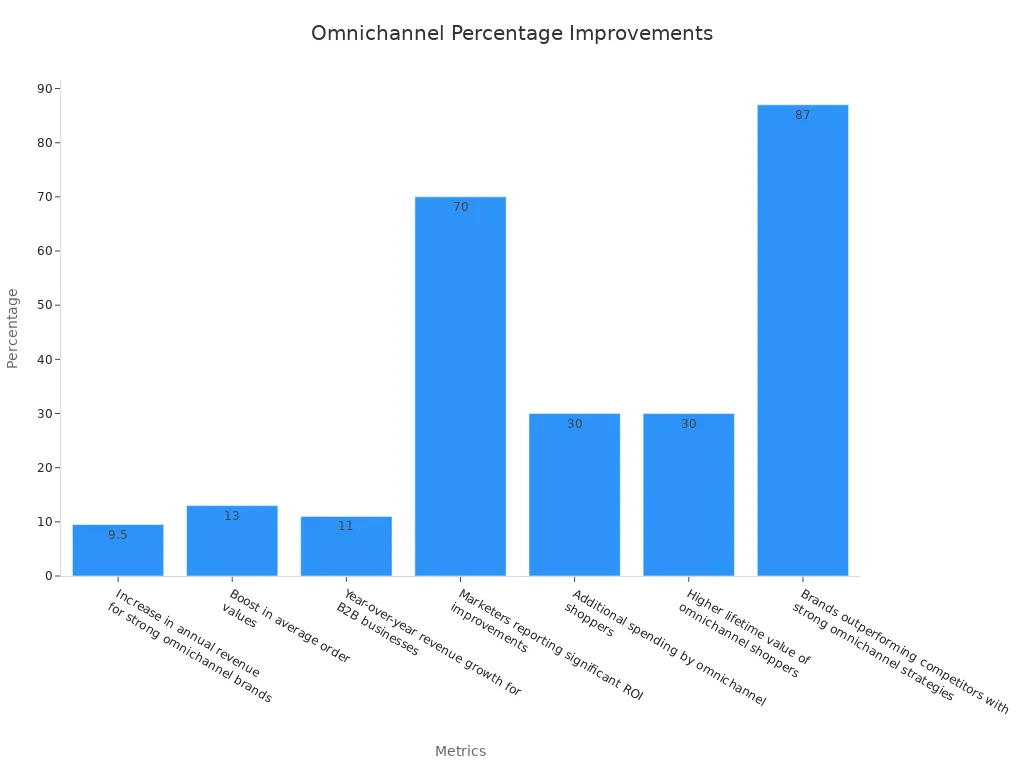
Omnichannel strategies outperform single-channel and multichannel approaches in every key area of brand management. Brands like KFC, Disney, Starbucks, and Sephora set the standard for consistent, integrated experiences. These leaders unify customer data, enabling tailored content and seamless transitions between channels. As a result, they achieve higher customer engagement, increased revenue, and greater brand agility.
Key advantages of omnichannel strategies include:
Improved personalization through integrated customer data.
Higher lifetime value and increased spending from omnichannel shoppers.
Enhanced convenience, allowing customers to engage on their preferred platforms.
Stronger brand resilience through consistent messaging and unified experiences.
Greater brand agility, enabling rapid response to market changes and customer feedback.
Academic research confirms that omnichannel integration optimizes customer experience and loyalty. Personalization, connectivity, and a customer-centric approach drive success, setting omnichannel strategies apart from less integrated digital marketing strategy models. Brands that invest in centralized data platforms and clear guidelines ensure consistency, supporting both brand resilience and brand agility.
Tip: To maximize the benefits of omnichannel strategies, brands should regularly audit their customer journey, update digital marketing strategy guidelines, and invest in technology that supports real-time integration and measurement.
Technology & Personalization
AI and Automation
AI and automation have become essential drivers of brand transformation in 2025. Brands now use advanced algorithms to analyze customer data, predict behavior, and deliver hyper-personalized experiences at scale. These technologies enable teams to automate repetitive tasks, freeing up resources for creative brand innovation and strategic decision-making.
Recent market data highlights the impact of AI-driven automation on brand strategy optimization and customer engagement:
80% of consumers are more likely to buy from brands offering personalized experiences.
Over 70% of consumers expect personalization as a standard service.
42% of consumers feel frustrated when content is irrelevant to them.
AI enables real-time hyper-personalization by analyzing large datasets and delivering tailored content at scale.
59% of marketers in enterprises currently use AI to enhance personalization.
57% of large enterprise marketing teams plan to increase AI usage, signaling mainstream adoption.
80% of marketers believe AI will revolutionize marketing by 2025.
Industry leaders, including Salesforce CEO Marc Benioff, recognize AI as a game-changer for delivering personalized experiences.
Brands.menu stands at the forefront of this shift. The platform uses AI to automatically discover and map every brand touchpoint across digital channels. This automation eliminates manual asset collection, ensuring that no touchpoint is missed and that brand managers gain a complete, real-time view of their brand presence. By leveraging AI, brands.menu empowers teams to focus on brand strategy optimization and creative brand innovation, rather than administrative tasks.
Data-Driven Insights
Data-driven insights have transformed brand management, enabling organizations to make informed decisions and adapt quickly to changing customer needs. Real-time analytics provide a competitive edge, supporting brand agility and continuous improvement.
Brands.menu delivers a visual-first approach to brand management. The platform’s real-time brand experience timeline allows users to see their brand exactly as customers do, tracking the evolution of messaging and identifying gaps in the journey. This visual mapping supports brand strategy optimization by revealing actionable insights and opportunities for brand innovation.
Note: 73% of organizations consider real-time analytics crucial for competitive advantage, but only 42% have implemented it. Companies using customer analytics are 23 times more likely to excel in customer acquisition and 19 times more likely to achieve above-average profitability.
Brands.menu also prepares teams for the future of brand transformation with competitive intelligence features. These tools monitor competitor strategies, uncovering opportunities for differentiation and supporting brand agility in fast-moving markets.
Case Studies: Measurable Benefits of Integration
Case Study | Brand Type | Integration Strategy / Key Actions & Tools Used | Measurable Benefits |
|---|---|---|---|
1 | Large E-commerce | AI-driven predictive integration across channels | 15% increase in cross-channel conversion rates, 20% improvement in customer satisfaction |
2 | Large Coffee Chain | Real-time data synchronization across app, website, POS | 25% increase in mobile order-ahead usage, improved customer satisfaction related to info accuracy |
3 | Global Retail Brand | CRM-driven personalized campaigns, social listening, CMS redesign | 25% increase in engagement, higher conversion rates |
4 | Boutique Fashion Brand | AR virtual try-ons, social media campaigns, analytics tools | 30% increase in social media engagement, expanded digital footprint |
These examples show how integrating platforms like brands.menu streamlines monitoring, mapping, and optimizing brand touchpoints. The result is measurable gains in engagement, satisfaction, and conversion rates.
Quantifying ROI in Automated Brand Management
Research findings show that automated brand touchpoint discovery tools deliver significant ROI. Incrementality measurement isolates the true impact of marketing activities, allowing marketers to optimize budget allocation and focus on high-impact channels. For example, companies using sophisticated segmentation and automation report revenue increases up to 760%. Starbucks’ personalized rewards program, powered by automated data integration, drives over 40% of sales transactions. Dollar Shave Club’s data-driven marketing automation helped the company grow to a $1 billion valuation in five years. Organizations implementing continuous A/B testing and multi-touch attribution see annual performance improvements of 15-25% in key marketing metrics.
Brands.menu supports these outcomes by providing real-time monitoring, actionable insights, and a unified view of the customer journey. The platform’s visual brand experience timeline and competitive intelligence features enable teams to adapt quickly, supporting brand agility and ongoing brand innovation.
Tip: Real-time analytics and automated mapping tools like brands.menu help brands maintain consistency, optimize strategy, and deliver exceptional customer experiences across every touchpoint.
Self-Service & Support
Empowering Customers
Empowering customers through self-service tools has become a cornerstone of modern customer lifecycle management. Brands now recognize that customers want control over their journey, from discovery to advocacy. Self-service options, such as automated FAQs, chatbots, and self-checkout systems, enable customers to resolve issues quickly and efficiently. These tools support every stage of the lifecycle, driving engagement and reducing friction.
A quantitative study in Malaysian supermarkets demonstrated that well-designed self-service brand management support leads to higher customer satisfaction. Customers reported shorter queues, faster service, and greater usability with self-checkout systems. Positive experiences with these technologies increased satisfaction, which in turn promoted loyalty and operational efficiency. When customers feel empowered, they engage more deeply with the brand, moving smoothly through the lifecycle and increasing their likelihood of advocacy.
Brands that invest in intuitive self-service platforms see measurable improvements in customer engagement and retention. These solutions allow customers to access personalized offers, manage their accounts, and track their journey independently. By integrating self-service into customer lifecycle management, brands foster loyalty and encourage repeat engagement at every touchpoint.
Tip: Regularly update self-service resources to reflect customer feedback and evolving needs throughout the lifecycle.
Proactive Communication
Proactive communication transforms the customer experience by anticipating needs and addressing concerns before they escalate. Leading brands use data-driven insights to reach out with relevant offers, updates, and support at key lifecycle moments. This approach strengthens customer engagement and builds trust, which are essential for long-term loyalty and advocacy.
Research highlights the impact of proactive communication on brand loyalty. Patagonia’s transparent supply chain practices led to a 30% sales increase, while Starbucks’ ethical sourcing communication resulted in 75% of customers preferring Starbucks over competitors. Broad River Retail’s proactive journey strategies reduced customer resolution time by 80% and decreased product returns, demonstrating the value of addressing issues before customers seek help.
Company | Proactive Communication Strategy | Measurable Results |
|---|---|---|
Chick-fil-A | Personalized promotions and rewards via loyalty app | Increased customer retention and lifetime value |
Starbucks | Exclusive offers through Starbucks Rewards program | Higher NPS and repeat purchase rates |
7-Eleven | Points-based offers and discounts via 7Rewards | Improved app usage and customer retention |
Customer lifecycle management teams should prioritize collecting feedback and closing the loop with dissatisfied customers. Proactive engagement, such as reaching out to lapsed customers or offering personalized solutions, enhances emotional connection and drives engagement across the lifecycle. Brands that excel in proactive communication see higher retention, greater advocacy, and increased customer engagement at every stage.
Brand Messaging Consistency
Unified Voice
A unified brand voice builds trust and recognition in every customer interaction. Brands that maintain a consistent tone, language, and visual identity across all channels create a seamless experience. Clear brand guidelines define these elements, ensuring every team member communicates with the same intent. This approach supports both customer loyalty and long-term retention.
Customers are 3.5 times more likely to make a purchase when recognized across multiple channels.
Average order values rise by 13% when messaging adapts based on previous touchpoints.
A 10% Share of Voice advantage often leads to a 0.5% annual market share growth.
Cross-channel marketing strategies achieve 3 to 4 times higher Share of Voice than single-channel efforts.
Maintaining a unified voice also strengthens brand recall. Consistent messaging helps customers remember the brand, which increases the likelihood of repeat engagement. Brands that invest in cross-channel consistency see measurable improvements in retention and market share.
Maintaining a consistent brand voice and identity across all platforms is crucial for building brand recognition and trust. Clear brand guidelines that define voice, tone, and visual identity help ensure a unified brand experience, which supports the effectiveness of cross-platform marketing strategies.
Adapting Across Platforms
Adapting brand messaging for diverse platforms ensures relevance and impact. Each channel—social media, websites, or advertising—has unique audience expectations and content formats. Brands that tailor their messaging for each platform achieve higher engagement and stronger customer connections.
Metric | Description | Benchmark Range |
|---|---|---|
Message Clarity | Percentage of target audience understanding the core brand message | 70% to 90% |
Message Consistency | Degree to which messaging aligns across all platforms | 80% or higher |
Brand Sentiment | Positive audience perception of brand messaging | Above 60% |
Social listening tools provide real-time insights into consumer sentiment and preferences. Marketers use these insights to adjust messaging quickly, ensuring clarity and consistency. Predictive analytics help anticipate trends, allowing brands to stay ahead and maintain strong retention rates. Multichannel marketing approaches also increase ROI by reaching audiences where they are most active.
Tip: Brands should regularly review social media data and customer feedback to refine messaging and maximize retention across all digital touchpoints.
Measuring Touchpoint Success
Key Metrics
Successful brand touchpoint management relies on tracking the right metrics throughout the customer lifecycle. Teams monitor the volume of mentions to gauge brand visibility and awareness. Return on Investment (ROI) measures the profitability of campaigns, while social media reach shows how many unique users see brand content. Customer satisfaction metrics, such as Net Promoter Score (NPS), Customer Lifetime Value (CLV), and Customer Retention Rate (CRR), provide insight into loyalty and overall brand perception. These metrics help teams understand the effectiveness of each touchpoint and its impact on the lifecycle.
Specific Metrics | Description / Purpose | |
|---|---|---|
Financial Metrics | ARR, MRR, CAC, CLTV | Measures revenue growth, customer acquisition cost, and lifetime value to link marketing efforts to business outcomes. |
Messaging & Engagement | Messaging effectiveness, Adoption rates, Usage frequency, DAU/WAU/MAU, NPS | Tracks clarity of communication, user engagement, and customer loyalty. |
Retention & Satisfaction | Churn rate, Renewal rate, Customer Satisfaction (CSAT) | Evaluates post-sale experience quality and customer retention. |
Market & Campaign Metrics | Win/loss ratios, Deal size, Competitive displacements, Campaign ROI, CPL, MQL-to-SQL conversion | Assesses market position and effectiveness of demand generation campaigns. |
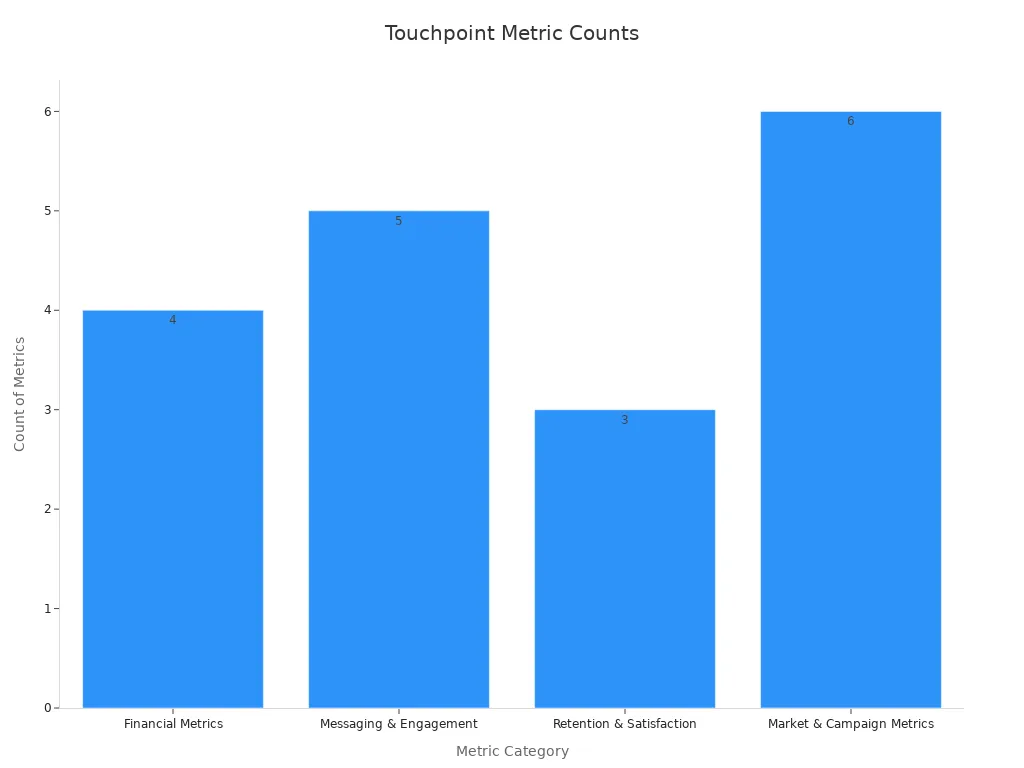
Platforms like brands.menu provide real-time dashboards that visualize these metrics across the entire lifecycle. Teams can track engagement, sentiment, and conversion rates as they happen, ensuring no critical moment in the lifecycle goes unnoticed.
Continuous Improvement
Continuous improvement in brand touchpoint management depends on regular review and optimization. Teams collect feedback at every stage of the lifecycle, using it to identify pain points and opportunities for enhancement. For example, a retail chain improved retention and market share by acting on NPS feedback, while a hotel chain boosted online ratings by simplifying the booking lifecycle.
Tech companies reduce Average Handle Time by upgrading support technology, improving the lifecycle experience.
Financial services providers use CSAT to uncover training gaps, optimizing processes for repeat business.
Brands like Taylor & Hart double revenue by tracking NPS at multiple lifecycle stages and refining their service based on feedback.
Brands.menu supports this process by enabling teams to monitor touchpoints, gather feedback, and implement changes quickly. Real-time analytics and closed-loop feedback systems ensure that every adjustment leads to measurable gains in satisfaction, loyalty, and lifecycle value.
Tip: Collecting feedback from multiple channels and acting on it throughout the lifecycle drives sustained improvements in key brand metrics.
Strategic, tech-enabled management of brand touchpoints drives long-term success. Leading companies use unified platforms to deliver seamless customer experiences and foster brand innovation. The following table highlights how digital integration, innovation, and agility support these strategies:
Key Focus Area | Supporting Points |
|---|---|
Digital Integration | AI-driven campaigns, data-driven decisions, omnichannel optimization |
Innovation & Resilience | Leadership, adaptability, crisis-proof brand architecture |
Brand Agility | Flexible strategies, creative culture, robust digital investments |
Outcome | Strong brand value, consistent customer experience, future readiness |
Unified brand management platforms like brands.menu help teams adapt strategies, maintain consistency, and measure success. Companies such as Starbucks, Adobe, and Domino’s have achieved measurable gains by optimizing customer touchpoints. Embracing these strategies ensures every customer receives a compelling experience and positions brands for ongoing brand innovation in 2025 and beyond.
FAQ
What are brand touchpoints, and why do they matter in 2025?
Brand touchpoints include every interaction a customer has with a brand. In 2025, these moments shape perception, drive loyalty, and influence purchasing decisions. Brands that manage touchpoints effectively gain a competitive edge and foster stronger customer relationships.
How does brands.menu help teams manage brand touchpoints?
Brands.menu automatically discovers, maps, and monitors all digital brand touchpoints. The platform provides a real-time, visual timeline of the customer journey. Teams use these insights to ensure consistency, identify gaps, and optimize brand strategy across channels.
What metrics should brands track to measure touchpoint success?
Key metrics include Net Promoter Score (NPS), Customer Lifetime Value (CLV), conversion rates, and engagement rates. Monitoring these indicators helps teams evaluate the effectiveness of each touchpoint and supports continuous improvement.
Can brands.menu support competitive analysis?
Yes. Brands.menu offers competitive intelligence features. Teams can monitor competitor brand touchpoints, analyze messaging strategies, and uncover opportunities for differentiation. This capability helps brands stay agile and innovative.
Why is consistency important across all brand channels?
Consistency builds trust and recognition. Customers expect the same voice, visuals, and values on every platform. Brands that deliver a unified experience increase loyalty, drive engagement, and outperform competitors.
See Also
Innovative Strategies For Enhancing Marketing Touchpoint Effectiveness
Unlock Your Brand’s Full Potential Using Proven Marketing Tools
The Importance Of Visual Communication In Today’s Branding
Top Marketing Tools Every Brand Should Consider Using
Ten Must-Have Tools To Achieve Branding And Marketing Success

Try our Brand Suite for FREE

